


“When we’re preserving, like, the character of Marblehead—we’re selfish. We’re doing a bad thing. Like, we’re not doing any housing.”
“Is that a question?”
“Yeah, kinda. Like, are we kinda being pricks? Are we trying to do nothing? Because it seems like we’re doing nothing.”
That was David Modica, a 35-year-old Marblehead resident, addressing a Planning Board member at his town’s annual meeting last Monday night. The video went viral on X. But his town’s attempt to circumvent state regulations designed to force them to build more housing passed anyway—despite Modica’s best efforts, Marblehead went ahead with doing nothing.
The town’s plan complies with the MBTA Communities Act, also known as 3A, the state law requiring transit-served towns to zone for multifamily housing, by designating a private golf course as the new housing zone. There will be no housing built on that golf course. That’s the point, as housing construction means some amount of upheaval and cheaper housing. Marblehead’s homeowners don’t want to see that happen.
This speech was only possible because of a strange institution: town meeting. New England has a form of local government that exists almost nowhere else in America, and on a good night it produces moments like Modica’s speech. On most nights, it produces zoning plans like Marblehead’s.
Marblehead, my hometown of Brookline, and many other New England municipalities use this “town meeting” system of governance. There is debate around the origin of town meeting, but one theory is that it comes from the practices of the Pilgrims, who gathered to adopt the Mayflower Compact as soon as they landed in Plymouth.
Certainly, today we in New England consider this a tradition passed down to us from our colonial forebears. Town meeting has been repeatedly pointed to as a notable example of direct democracy at work; Alexis de Tocqueville, who I’m sure most Americans have read, ascribed the high level of political independence demonstrated in nineteenth-century New England towns to this very structure. And Thomas Jefferson described town meeting as “the perfect exercise of self-government and for its preservation.”
These days, town meeting today isn't quite the direct democracy it was two centuries ago. For one thing, towns are bigger now, so it’s harder for each individual to contribute directly to forging the town and its laws. In the modern era there are two different versions of town meeting: open town meeting, which allows any eligible town resident to come to meetings and vote directly on issues that they care about, and representative town meeting.
My hometown of Brookline, which with 63,000 people is the largest town in Massachusetts and among the largest municipalities in the country with a town meeting structure, uses the representative form. We elect 255 (!) people, 15 from each of 17 small precincts, to sit and debate the issues.
Brookline has no mayor. Our legislative power rests with these 255 members, who are in no way representative of the broader Brookline population. In a town where 52% of households rent, 85% of town meeting members own their homes. Their median age is 61, nearly twenty years older than the median adult resident.
Brookline’s size has forced it away from open town meeting into that representative structure, but some other municipalities still stick with it. In Marblehead, somewhat unusually for a town of 20,000, truly anyone can go to meetings, speak their mind, and cast a vote.
It’s thanks to this structure that 35-year-old Marblehead resident David Modica could approach the podium to share his thoughts on their recent attempts to circumvent compliance with the MBTA Communities Act. The video really is worth watching. It looks like it doesn’t render successfully through the embedded tweet, but if you click through you can watch it.

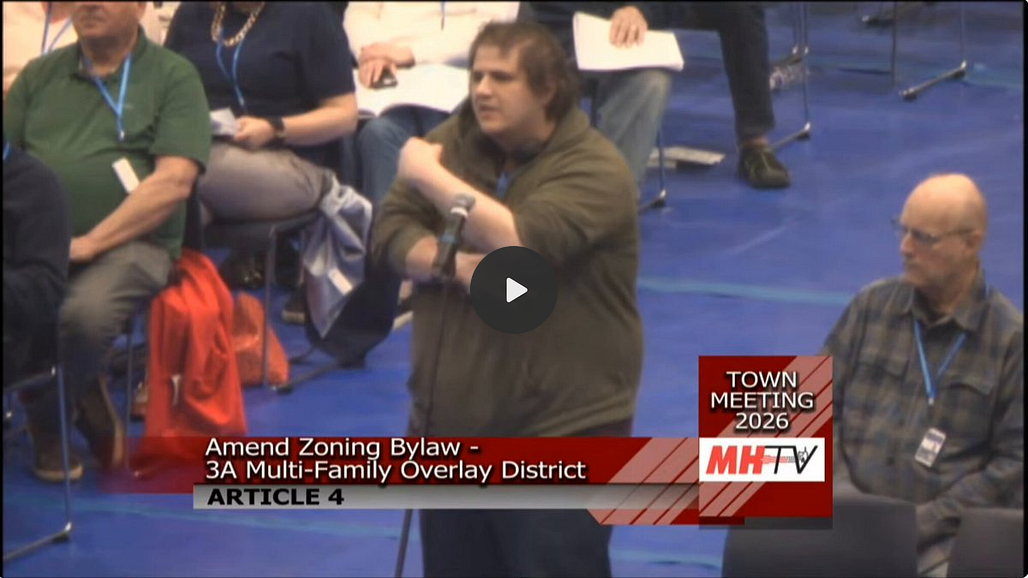
Modica gets to the point: “So, this is a way to comply with 3A without doing any of the 3A stuff? When we’re preserving the character of Marblehead, we’re selfish. We’re doing a bad thing, we’re not doing any housing.”
His final question was almost rhetorical: “I just wanted to make sure we’re voting on nothing substantive. I was afraid…” Planning Board member Marc Liebman confirmed it for him, saying: “You’re not missing anything.”
The town’s attempt to do nothing passed 881 to 82. As Modica put it in a follow-up interview with the Marblehead Current: “What would be better is if people built some fucking housing. People a lot smarter than me have been talking about it for years. People aren’t confused. They just don’t want more housing.”
Alas, the openness of an open town meeting doesn’t translate into accurate representation of a population’s best interests. Showing up costs time, and time is unequally distributed. The people who consistently show up are disproportionately civically-minded retirees: wealthier, older, whiter, and more likely to own their homes. Boston University political scientist Katherine Levine Einstein and her co-authors studied public meetings in 97 eastern Massachusetts cities and towns and found that participants were demographically unrepresentative of their communities, and they notably called out the ideological skew that many of these people were “overwhelmingly opposed to new housing.”
A structure which asks consistent engagement of citizens is one that prioritizes the exact people who don’t want more housing: homeowners with the time and energy to gunk up processes. Modica’s wonderful, snarky, very Boston questions won’t change Marblehead’s stance on this issue.
This problem isn’t unique to town meetings, and is illustrative of a dynamic that can block more than just housing reform.
Francis Fukuyama has a name for this kind of dysfunction: vetocracy. Coined to describe federal-level gridlock, the concept is straightforward. American political institutions have accumulated so many veto points that small organized minorities can routinely block changes a broader majority would benefit from. Structures like representative town meeting calcify the control of the elderly.
Unfortunately, “more democracy” isn’t a foolproof answer. For one thing, when it comes to this sort of local election the median voter is often wildly disproportionate, much like the median town meeting member. For Brookline’s May local elections, the median voter has historically been 17 years older than the median adult resident, only marginally better than the 19 year-gap between town meeting members and residents.
Additionally, even perfectly applied democracy in a town like Brookline or Marblehead excludes all those people who would like to live in the place. Why do we prioritize incumbents over those people who could live in the locale in the future? In the case of Marblehead, we actually got to this outcome after a townwide referendum. The issue is that the desires of Marblehead’s voters are not aligned with the welfare of the people of the commonwealth of Massachusetts.
The core problem here is one of coordination. The costs of new housing land on an existing population, particularly on homeowners, while the benefits are spread thinly across thousands of would-be residents who don’t live there and will never have a political voice locally. Concentrated costs reliably out-organize diffuse benefits. When we only give a political voice to the ones bearing concentrated costs, you get a highly restrictive zoning regime.
This dynamic isn’t unique to New England or to town meeting. California produces its own vetocracy through completely different institutions such as environmental review and discretionary permitting, and they have the same concentrated-costs-and-diffuse-benefits problem.
The answer is more centralized control. A town meeting member answers to a few hundred neighbors who turned out in May, but a governor answers to seven million people, most of whom rent or wish they could afford to. State politics aggregates the diffuse beneficiaries that local politics can’t.
This matters especially in Massachusetts, which has seen net domestic outmigration despite world-class educational institutions and the second-highest Human Development Index in the country; housing costs are the wedge pushing people out. I applaud former Governor Charlie Baker, a Republican, for signing the MBTA Communities Act, and I applaud current Governor Maura Healey, a Democrat, for her efforts to enforce it and get municipalities to act with the collective good in mind. It’s executives such as these who can take more decisive action, optimizing on long-run outcomes.
Many municipalities have found a way around the law, but the Leviathan that is state power in Massachusetts is punching back. Attorney General Andrea Campbell is suing Marblehead and other towns to force compliance, and excluding them from infrastructure grant programs if they continue to resist.
It takes this sort of elbow grease to make the world a better place. We must not be complacent in the face of self-interested behavior that harms the whole.

CT has something similar. 10% of the housing stock must be affordable, otherwise the towns/P&Z boards can be sued by the state. In my town, this has manifested largely in townhouses in the center of town and some higher density developments near entrance ramps. In addition to more housing, it might turn out to be a great way to fight sprawl and lower density, cookie-cutter planned developments. This is because there is an easier path to build housing which obeys this 10% rule, which may disincentivize developers from buying old farms and building unappealing, inefficient, and expensive culs-de-sac (yes, this is the plural of cul-de-sac...I learned this from the Gilmore Girls!). Moreover, my hope is that developers continue to build up the center of town—which ideally would result in more storefronts, cafés, and general walkable infrastructure. Since this would take supplement most of the housing, it would be nice if the town could absorb some of the old historic farms into the land trust to use as parks/green space for the people to enjoy. This would preserve that beautiful land and attract people to fill out those new affordable homes!
This great. Build more housing.