

In Émile Durkheim’s The Elementary Forms of Religious Life, the French sociologist looks to the indigenous populations of Australia to analyze what religion is like in its “elementary” form in order to learn more about modern religion and society writ large.
Durkheim believes that the indigenous people that he studies live in two basic phases: one mundane phase in which the population is spread out, focused on foraging and hunting in order to support themselves in small family units, and one sacred phase in which the population comes together in a large gathering that generates “a sort of electricity … launch[ing] them to an extraordinary height of exaltation.” A symbol called a totem is present during these gatherings. The totem comes to represent both the emotion felt during the meeting and the group more broadly.
He calls that emotion collective effervescence. The experience of participating in shared customs is powerful and leads to a loss of individuality during the ceremony. Durkheim describes how at these gatherings individuals gain a heightened sense of courage and act as if led on by some external power. Here, religion is a shared social phenomenon in which people with a set of shared experiences come together around some emblem, some totem, and through the totem and through one another they feel a touch of the divine.
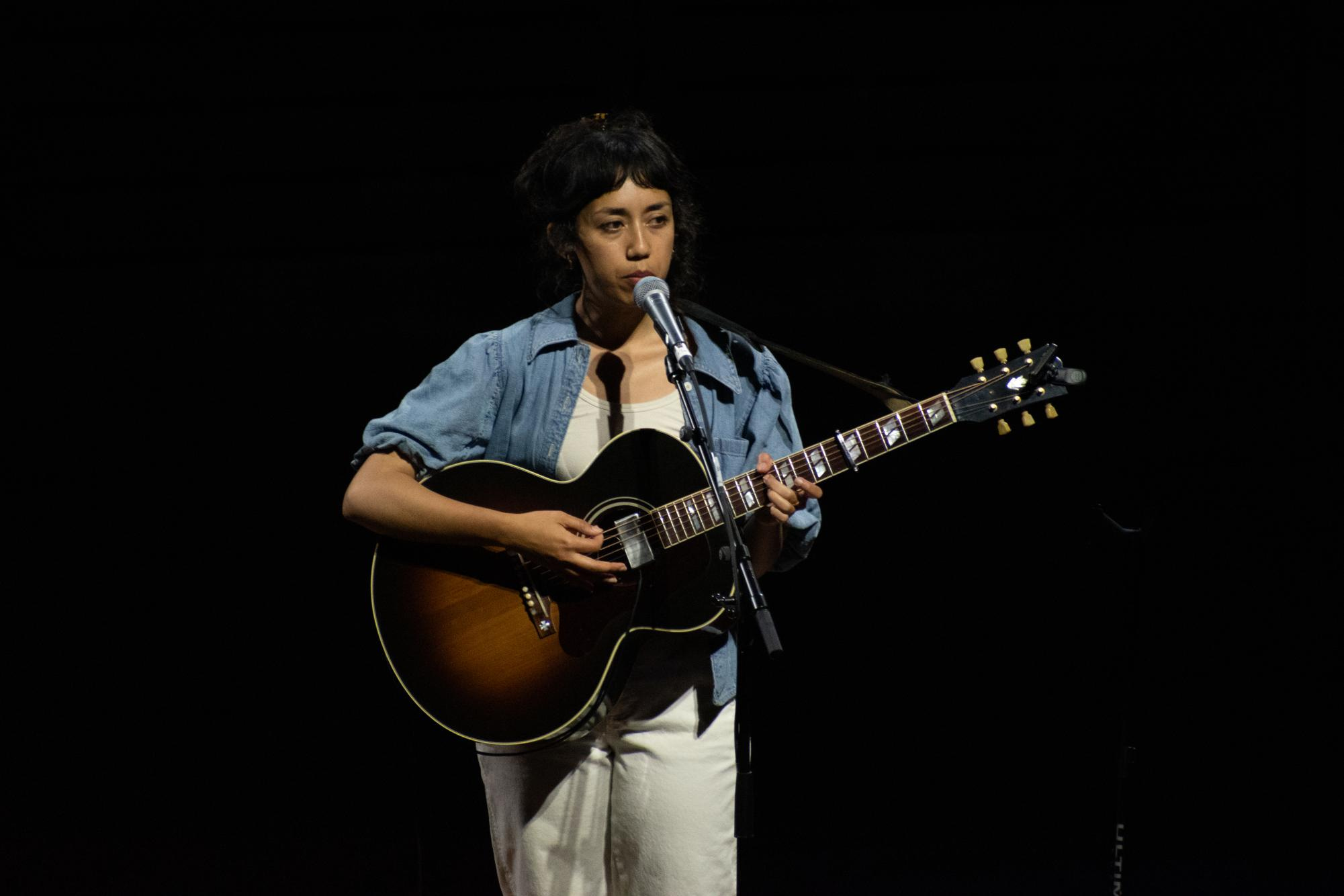
I found myself thinking about Durkheim and collective effervescence as it applies to the 21st century last night while watching Haley Heynderickx in concert at Thalia Hall. In our largely secular world, we all look for spiritual significance in the mundane around us. Some of us place something not entirely unlike faith in the larger-than-life figures we see on television, or in the characters we read about in books. And many of us are able to have experiences approaching the spiritual through music.
Haley Heynderickx, a Portland-based indie folk artist, focuses her own songwriting on the hunger to find connection with the world around you. Sometimes that’s connection with the natural world, as in her song “Redwoods (Anxious God)” from her new album Seed of a Seed. In each verse, Heynderickx converses with the natural world, and learns about the past connections that we have since lost. The song begins:
My God, my ancient God
Well, I couldn't believe what the water had told me
That man and plant had used to talk
Man, I'd do anything to hear the redwoods talk
Through communing with nature, Heynderickx gleans that we used to be able to far more connected with the world around us. And what she wants, more than anything, is to hear the giant redwood trees of her native Oregon and all that they have seen. In the next verse, she claims that man and bird used to sing to one another but that “Well now the only man here’s cell phone rings, rings, rings.” That’s just one example of the direction us humans are moving in, which she bemoans as she sings “That humankind is getting lost / Not even the bugs wanna talk with us, us, us.” The people in this song are out of sync with the world around them, no longer able to engage spiritually with nature.
In other songs, Heynderickx turns to those around her for spirituality. She spends much of “Oom Sha La La” from her 2018 album I Need to Start a Garden worrying about her own life, starting with the defeated line “The milk is sour” and claiming that “The brink of [her] life essentially is a comedy.” She finds modern life absurd, and the proposed antidote is to go outside and experience as much human connection as she can, to take agency over her own life.
If you don't go outside
Well nothing's gonna happen
She'll never write her number on a crumpled up napkin
She'll never be your ego
She'll never be a bandit
She’ll never get to eat you like your heart’s a pomegranate
I’m throwing out the milk
The olives got old
I’m tired of my mind getting heavy with mold
I need to start a garden
I need to start a garden
I need to start a garden
I need to start a garden!
For Heynderickx, is starting a garden a communal project? Is it a spiritual one? What about her music?
On stage it certainly appeared that Heynderickx’s musical career, one garden she has tended to over the years, is collaborative in nature. Her opener was harpist Lily Breshears, who collaborated with her on both of her albums. Breshears had 83 monthly listeners on Spotify at the time of the concert. Heynderickx shouted her out, mentioning that Breshears is looking to sign to a label, and otherwise dedicated more time than any other artist I’ve seen to introductions and banter from her bandmates. It was clear that they cared deeply for one another.
On a few occasions during the show Heynderickx made reference to living life in the “twenty-first century,” which I took as a reference to the human condition in a post-industrial society, to trying to find meaning in a world around us that can feel fractured. Perhaps she finds that meaning in her bandmates, perhaps not.
Within that concert hall, the world felt anything but fractured. The crowd looked up at Heynderickx and the other musicians with adoring eyes and earnestly approaching each song with excitement. For one night, Heynderickx was their totem, a symbol of the divine and a means through which we achieve connection with the world around us.
A couple songs into the show, I looked to my right and noticed a girl at the barricade, maybe 16 years old, who was bouncing up and down with a frenetic energy that’s difficult to put into words. She wasn’t dancing, which would imply a level of control over the action that she did not have. Instead her body was being filled to the point of overflowing by raw emotion, and the only way to process that energy was for her to jump up and down, gripping the barricade to ensure that she didn’t simply float away.
I don’t think I’ve ever seen someone go through that much collective effervescence in my life. The remarkable thing was that, while the crowd was clearly enjoying the music, for most of the first hour Heynderickx was only playing songs from Seed of a Seed, which was released just over a week before the performance. In my own time going to concerts, the strongest manifestations of collective effervescence come when the artist plays a song that already holds emotional resonance with concertgoers. In the middle of the show I whispered to my friend, who didn’t know Heynderickx’s discography well: “just wait until she plays ‘Oom Sha La La’. That girl is going to go crazy.”
And I was right. If anything, I understated the effect. When “Oom Sha La La” reached its climax and Heynderickx screamed about her need to start a garden, the bouncing girl went berserk but so did everyone else there. We were all bound together by our shared emotional connection with the music and its progenitor and avatar, who was dancing in front of us, kicking things over on the stage. The woman directly behind me was belting the lyrics, but I wasn’t bothered; I let myself go to the experience too, and my mind went blank as I took it all in.