


In 1994, cognitive psychologist Steven Pinker coined the term euphemism treadmill1 in a New York Times column. The euphemism treadmill is the process by which people come up with new words, euphemisms, to refer to some undesirable thing, only for the euphemism itself to become tainted by association such that in the future another euphemism is necessary.
We call this the euphemism treadmill because it just keeps running, eventually becoming disconnected from any potentially suggestive etymology that could harm people. For example, the terms “idiot,” “imbecile,” and “moron” were all popularized as medical conditions to refer to people within specific IQ bands, but soon became more known as schoolyard insults and were phased out by medical professionals in favor of terms like “mental retardation” until that became derogatory too. Next up was “special needs,” but that fell victim to the euphemism treadmill as well. These days people who wish to avoid causing offense are more likely to use a term like “developmental disability” to refer to the same medical conditions.
Pinker believed that this whole process is silly. It relies on the notion that using a pejorative term affects our brains by causing us to see certain groups or concepts more negatively, but Pinker said "that “no cognitive scientist believes” that language determines thought. He decried the euphemism treadmill as “P.C. aerobics,” and argued that those who adopt the latest terms do so not to respect the disenfranchised but to show that they are “subscribing to the right magazines or going to the right cocktail parties.”
Pinker’s 1994 example of the euphemism treadmill in action was the then-new Los Angeles Times “Guidelines on Racial and Ethnic Identification.”2 These guidelines request that we stop using terms like “crazy,” “stepchild,” and “WASP” in order to be maximally respectful. Pinker doubted that all of these terms truly hurt the communities they refer to, arguing that we should just ask people what they want to be called instead of taking it upon ourselves to, say, refer to the deaf as “individuals who cannot hear.”

Since the LA Times updated its style guide in 1994, the euphemism treadmill has not stopped. If anything, to extend the metaphor, the treadmill has sped up.
The best example of this is Stanford University’s 2022 Elimination of Harmful Language Initiative, or EHLI. The EHLI requested that we stop using terms like “American” because they center the United States at the expense of all the other countries in North and South America, that we replace “Karen” with “entitled white woman” and replace “blind study” with “masked study.” For Stanford it’s offensive to talk about your “spirit animal,” call it your “favorite animal” instead.
Pushback swiftly led Stanford to release a statement and then take the EHLI off of their websites. They were too ambitious in their attempts to steer the English language; they tried to make the euphemism treadmill go just a bit faster than people were ready for. Calling out the term “American” was one bridge too far.3
Stanford isn’t the only organization trying to change the way we talk. Equity-language guides are in vogue among all sorts of nonprofits; the Sierra Club, the American Cancer Society, the American Heart Association, the American Psychological Association, the American Medical Association, and the National Recreation and Park Association all have one.
This all feels rather ridiculous. But the euphemism treadmill is not just a benign sociolinguistic phenomenon, as it brings with it a host of real political ramifications. What are the consequences of the rapid speed of the euphemism treadmill? Is there an “off ramp” from the treadmill? The rest of this article will explore these questions and more.
The main problem with the euphemism treadmill going so fast is that it leaves people behind. If you aren’t moving in lockstep with the euphemism treadmill, it means that you are the problem. If you don’t use the right terms then you don’t just read the wrong magazines; you are ignorant at best and bigoted at worst. Those who do not inhabit the elite circles where new terms develop (academia, activist organizations) come to feel disdained by those who do use this language.
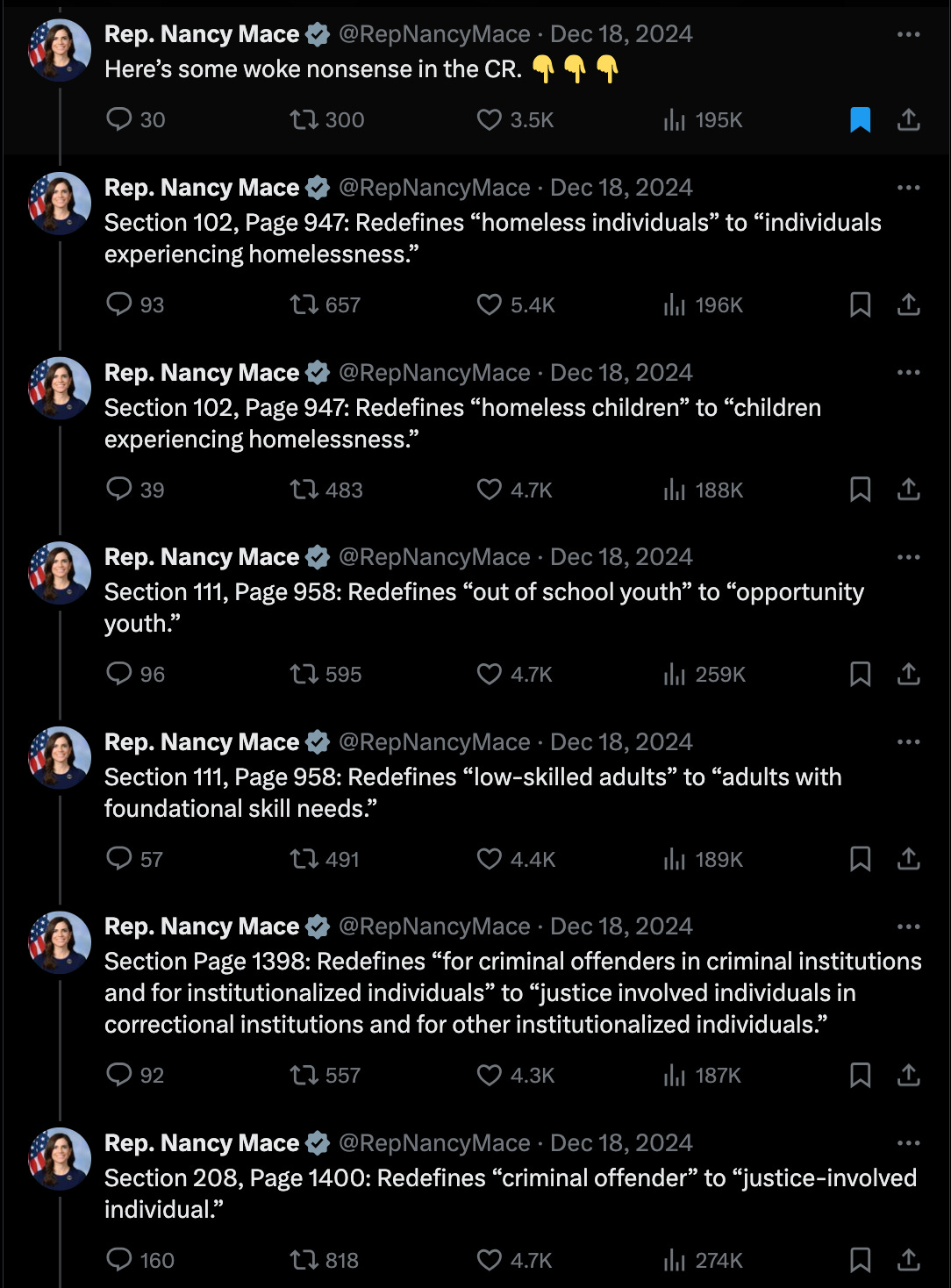
And so the treadmill’s high velocity in elite, progressive circles is tied to the Democratic party’s loss of support among the working people of America. Terms like “unhoused,” “Latinx,” and “differently abled” are just one more thing increasing the size of the social gulf between those who are plugged into the latest lefty jargon and those who are not.

Within elite institutions, being plugged into such debates signals that you are empathetic and knowledgeable, that you want to uplift the downtrodden of the world and have put in the work to learn the right terminology.4 But outside of those elite circles, all that this language does is show that you belong to those elite circles and remind people of that social gulf. This system where the experts decide what language is newly verboten and regular people are expected to keep up is terribly backwards.
The term “Latinx” is the best encapsulation of these trends. “Latinx” strives to be a gender-neutral version of the generic, male-gendered “Latino” to refer to people who hail from Latin America, but the term itself does not conform to the morphological and phonological rules of Spanish. It can’t really be pronounced in Spanish at all.
“Latinx” originated on internet chatrooms and was then adopted by American activists and academics. In a blog post titled “The Cross-Lingual Interse(x)tionality of ‘Latinx’,” humanities professor Jeffrey Herlihy-Mera describes “Latinx” as “a recognition of the exclusionary nature of our institutions, of the deficiencies in existent linguistic structures, and of language as an agent of social change.”
This is not how most people conceive of language. These are activist-brained concerns, and regular folks do not feel the need to contort the way they speak in order to stop using gendered forms in the language they grew up speaking. Pew Research polling from last September found that while almost half of all Latinos in America had heard of the term “Latinx,” only 4% have ever used it to describe themselves, while 75% of those who have heard the term say that it should not be used.
Still, the Democratic party creates space for terms like this. Elizabeth Warren said “Latinx” in a 2020 primary debate. In 2022, Alexandra Ocasio-Cortez called out some of her colleagues for voicing their opposition to saying “Latinx,” claiming that “another person’s identity is not about your re-election prospects; like, this is not about you.”
The problem with this argumentation is that our decisions to support one way of speaking over another are political. If the Democratic party is perceived as being aligned with the sorts of people who say “Latinx,” then that makes them look holier-than-thou and out of touch with real people who don’t worry about making their language maximally inclusive.
Latino Senator Ruben Gallego noted this in 2021, saying that “Latinx” was only used to appease “rich progressives.” The Democratic party is too credulous when dealing with activists who claim to speak on behalf of disadvantaged groups. These activists may share some basic superficial trait with the people they claim to represent but if they are an activist who is interfacing with government officials then they are never going to be a representative member of that group.
As Pinker said way back in 1994, we should try to figure out what people actually want, not what activists say they need. In the wake of the election, Matt Yglesias, Ezra Klein, and Adam Jentleson tried to get at the mysterious and distortionary political group that they referred to as “The Groups,” which appeared to hold great sway over staffers. We can consider activists who try to police language through government levers as one instance of “The Groups.”
Klein argues that it’s the job of political non-profits to demand more change than the electorate is necessarily ready for. We get progress when the left flank pushes for more than is politically viable and the electorate gradually comes around. This dynamic only works when politicians who are trying to establish an electoral coalition can draw a line between them and the activists in the sand in order to win votes. In time, the electorate will hopefully come around and then the politicians can move left.
During the Obama administration, this was a dynamic that worked; Obama was comfortable dissing the left on issues related to identity politics, possibly because he was himself a Black man. Since he left office in 2016, the Democratic party platform has hewed more closely than ever to the demands of activists, which Obama believes hurts Democrats at the ballot box.
Back in 2019, Obama said: “Even as we push the envelope and we are bold in our vision, we also have to be rooted in reality and the fact that voters — including Democratic voters and certainly persuadable independents or even moderate Republicans — are not driven by the same views that are reflected on certain, you know, left-leaning Twitter feeds or the activist wing of our party. The average American doesn’t think we have to completely tear down the system and remake it.”
Yet increasingly, members of the Democratic party apparatus move back and forth between non-profit and government spaces. The party’s platform is no longer firmly rooted in the reality that voters aren’t driven by “left-leaning Twitter feeds” as the difference in roles between those activists and politicians collapses.
Thankfully, since 2022 things have shifted in the right direction slightly for the party when it comes to language, even if “The Groups” still have far too much sway over policy. A search of AOC’s X account reveals that she hasn’t tweeted “Latinx” since 2020. She dropped the alternative“Latine” a couple times in 2022 and 2023, but these days she’s back to “Latino.”
However, even if politicians adjust the issue does not go away. It has become endemic to the most vocal part of the progressive base. Even if Democratic leadership stops saying “Latinx” and referring to “unhoused persons,” the rank and file lefty posters online will continue to race on the euphemism treadmill; the purity tests will not stop. The psychology of the internet means that people will continually look for new reasons to dunk on one another, and finding outdated language in decade-old tweets has long been fertile ground for allegations of bigotry.
So how do we get the euphemism treadmill to decelerate or even stop, among not just our politicians but more generally among progressives? A cultural change is necessary, one that would lower the value of the social signifier of using the newest term which itself would require that we stop elevating those who police language. Liberals would need to treat “The Groups” with skepticism, allowing activist rhetoric to be questioned. We need to remember that politicians and activists can disagree on policy for pragmatic reasons, and that disagreements don’t mean that the politicians are invalidating anyone’s identity.
We would need to move away from identity politics and move towards considering an individual’s material situation over superficial markers. Policy should be downstream of research on both outcomes and the electorate’s preferences.
Kamala Harris nudged us away from identity politics in the last election. But to get all the way there requires harsher breaks from those who would police language. As Hawaii’s Brian Schatz put it in a recent Politico interview, we must do away with “this idea that there are magic words that we must be forced to say defines progressivism and political courage by essentially saying whatever a bunch of activists want us to say, as opposed to doing the thing.”
There are no magic words. We cannot cede all moral authority to activists. Letting people speak the way they want is a start.

In 1974, linguist Sharon Henderson Taylor originated the concept under the name euphemism cycle. In historical linguistics, this process of an inoffensive word becoming pejorative is more generally known as pejoration.
I was unable to find the guidelines themselves. But a 1994 LA Times article covers the debate around political correctness and language in media. It mentions the recently updated LA Times guidelines and quoting the LA Times editor Shelby Coffey III as stating that “the struggle with language is a worthy task for a newspaper.”
Stanford apologized for maligning the term “American” in particular. In bold text, they wrote: “We have particularly heard concerns about the guide’s treatment of the term ‘American.’ We understand and appreciate those concerns. To be very clear, not only is the use of the term ‘American’ not banned at Stanford, it is absolutely welcomed.”
Why does the social signal of using language like this carry more value now then it did back in 1994? It moves hand-in-hand with rising awareness of the impediments facing marginalized people in our society. The social value of taking on such identities will be explored further in another article.
I notice your post contains 'Black', a word which is trying to replace the now-proscribed 'black'. The AP guideline on this says this is because all black people share a "sense of history, identity and community".
https://apnews.com/article/archive-race-and-ethnicity-9105661462
Excellent article. I think that this triumph of nomenclature ignores semantics and meaning. In my consulting I have also found that reliance on coded words most prevalent amongst those that desire change but don’t have the knowledge or capabilities or characteristics to lead change