

New de facto leader of Syria Abu Mohammad al-Julani says he values institutions. He understands the advantages of an economy based on free markets, and he gets the importance of an inclusive diversity in a country that has been torn apart by sectarian divides. In essence, he has aligned himself with the ideas that undergird the current world order.

It’s possible that some of this is lip service from al-Julani in order to gain acceptance from other state actors. But data indicates that he has taken the task of building simpler sorts of institutions far more seriously than his predecessor Bashar al-Assad. In Idlib, a city in northwest Syria that the rebels have controlled for most of the last decade, al-Julani’s group has distributed water and electricity, paved roads, and collected garbage.
These most basic benefits were not always provided by Assad’s government, and so the areas under his rule have struggled economically in recent years. We can look to Syria’s night-time light emissions, a reliable indicator of economic output, to see how economic growth in areas administered by the rebels has dwarfed that of areas administered by Assad.

Institutions matter, whether those institutions pave roads or ensure free speech. The seminal book on this topic is Why Nations Fail, by economists Daron Acemoglu and James Robinson. While their research has undertaken its fair share of criticism, it did win Acemoglu and Robinson (along with economist Simon Johnson) the 2024 Nobel Prize in Economics, with the Economics Prize Committee writing that the research of these economists has shown that “societies with a poor rule of law and institutions that exploit the population do not generate growth or change for the better.”
I’m not sure if al-Julani has read Why Nations Fail, but he is clearly aware of the ideas represented in the book. As Syria has begun its transition away from Assad’s dictatorship, he has invited in Western journalists to catalogue them and has claimed to want to set up robust institutions throughout the country so that Syria can thrive.
Meanwhile, in America our institutions have never looked more fragile. Americans have gotten fat and happy on the benefits of functional governance, and now we scorn them. America’s institutions, our norms, are actively crumbling all around us.
Last week ABC News decided to give Trump $15 million in a settlement rather than fight him in court over a defamation lawsuit. From a self-interested, ABC News perspective, maybe this made sense. Certainly there was a lot of risk entailed with going to court against the sitting president and having this case in the spotlight for months on end. And the judiciary has made all sorts of unprincipled decisions that would otherwise be out of line with conservative jurisprudence in order to empower Trump, so maybe ABC would be correct in assessing that they could have the deck stacked against them at trial.
Now that ABC capitulated, Trump is empowered to go after other news organizations that publish things he doesn’t like. He’s already found his next target: the Des Moines Register, not for defamation but merely for “election interference” by publishing a poll that ended up missing badly in favor of Kamala Harris.

Trump has long been litigious, and his legal efforts don’t always end well for him. This one probably won’t lead to a decision against the Des Moines Register, but the federal judiciary really has been off the rails lately. Really, the financial ramifications of the case don’t matter much for American society, or for Trump, or even all that much for Gannett, the giant holding company that owns the Des Moines Register.
What matters is the chilling effect that such litigation has on journalism in America. The press will be forced to handle Trump with kid gloves; any statement that could possibly be conceived as anti-Trump will have to be double, triple, quadruple-checked for accuracy, and any ambiguity will be unacceptable. The ABC case was not based on any blatant or intentional falsehoods and Trump still ended up with a $15 million settlement.

Even if the case against the Des Moines Register and pollster Ann Selzer doesn’t get anywhere, it could change the way that pollsters decide what data to release. As I’ve written previously, they already skew the numbers in order to exclude outliers; if an outlier result can lead to litigation, that will only become more common, which leads to worse data for the public.
This is a new paradigm. It doesn’t look like last time Trump was in power; now, his grip over the country is secured, and his particular mercurial style means that so much of the country exists only at his pleasure. The press will go easy on him for fear of retribution. And the judiciary has empowered him to do anything he wants; even walk on fifth Avenue and shoot someone.
During the run-up to the 2016 election, entrepreneur Palmer Luckey gave $10,000 towards Trump’s victory. Luckey, who founded Oculus VR and worked for Meta (then known as Facebook) after Meta acquired Oculus, came under fire immediately. A number of video game developers announced they would no longer support Oculus technology in their products, and Mark Zuckerberg unsuccessfully pressured Luckey into publicly supporting Libertarian Party candidate Gary Johnson over his preferred candidate of Trump.
Luckey left Meta less than six months later; his lawyers were able to secure a $100 million payout for Luckey by alleging that Meta had violated California law by discriminating against him for political reasons.
This was, of course, wrong. Palmer Luckey should have been able to support either of the two prominent presidential candidates without it leading to major ramifications for his career in tech.
Trump’s positioning relative to the nation’s cultural elite has shifted dramatically since Luckey made that donation over eight years ago. Back in September 2016, even though Trump was going to be on the ballot in the general election he was perceived as so grotesque that to support him as a public persona when you were anything other than a dyed-in-the-wool Republican made you a pariah.
Trump said what others wouldn’t, operating far outside of the aesthetic norms of American politics. He opened his campaign by calling Mexicans rapists. Trump wanted to lock Hillary up, to build a wall and make Mexico pay for it, to ban Muslims and to grab women as he pleased.
Even after the electorate validated Trump’s approach by electing him president in 2016, his continued disregard for norms—firing James Comey while he was investigating Russian election interference, refusing to release his tax returns, actually banning travelers from various Muslim countries—made it so that it was still impossible to support him in highly educated circles.
Somehow, the norm erosion itself became normalized between then and now. The pendulum swung back1 on what we might term the “woke” era of mainstream liberal politics, and so “unwoke” reactions to that era became increasingly common even from those who are not firmly on the right. Since the 2020 election many tech bros have gradually come out of the woodwork to gleefully declare their support for Trump, and unlike Palmer Luckey they were not cast out from the megacorporations they worked for.
Mark Zuckerberg is not one of those Trump-acolyte tech bros. Still, earlier this month Zuckerberg donated $1 million towards Trump’s inauguration. I doubt the Meta CEO has a MAGA bone in his body. But he will always act in the best interests of Meta, and paying fealty to Trump is one way for him to ensure that the company he has run since he was an undergraduate will not be targeted by the next bill that Congress passes just because Trump wanted to make a point.

Zuckerberg isn’t the only one paying his dues, of course. Jeff Bezos of Amazon and Sam Altman of OpenAI did the exact same thing, donating a symbolic $1 million to Trump’s inaugural fund in order to signal that their support for Trump and his regime. All three of these tech titans have tended to support liberal causes during their careers, and yet here they are, donating in support of the decidedly illiberal Donald Trump.
I don’t blame them. They’re acting reasonably given the political system we have in place under Trump, one where one man’s whims dictate policy in a manner America hasn’t seen for the better part of a century. It’s unfortunate that money is being wasted on appeasing Trump, and it’s unfortunate that the issues that our government addresses through legislation are no longer even the issues aligned with a political ideology that I disagree with but instead aligned with the highest bidder in this explicit fashion.
Of course money has long distorted our politics. Citizens United has made that all the more true since 2010. America has long needed substantial campaign finance reform, but these problems are greater than those posed by Citizens United alone; we’re entering a new phase of regulatory capture, one in which the major players in our economy need to pay tribute in order to keep one man happy.
This dynamic is more befitting of a developing country than the United States, which had long ago moved past such things. India deals with problems like this; Gautan Adani’s companies are worth so much because being friends with Narenda Modi is worth many billions of dollars in government beneficence. Elon Musk is now America’s Adani, as Tesla has skyrocketed in market capitalization since Trump’s election because Musk is currently Trump’s friend.
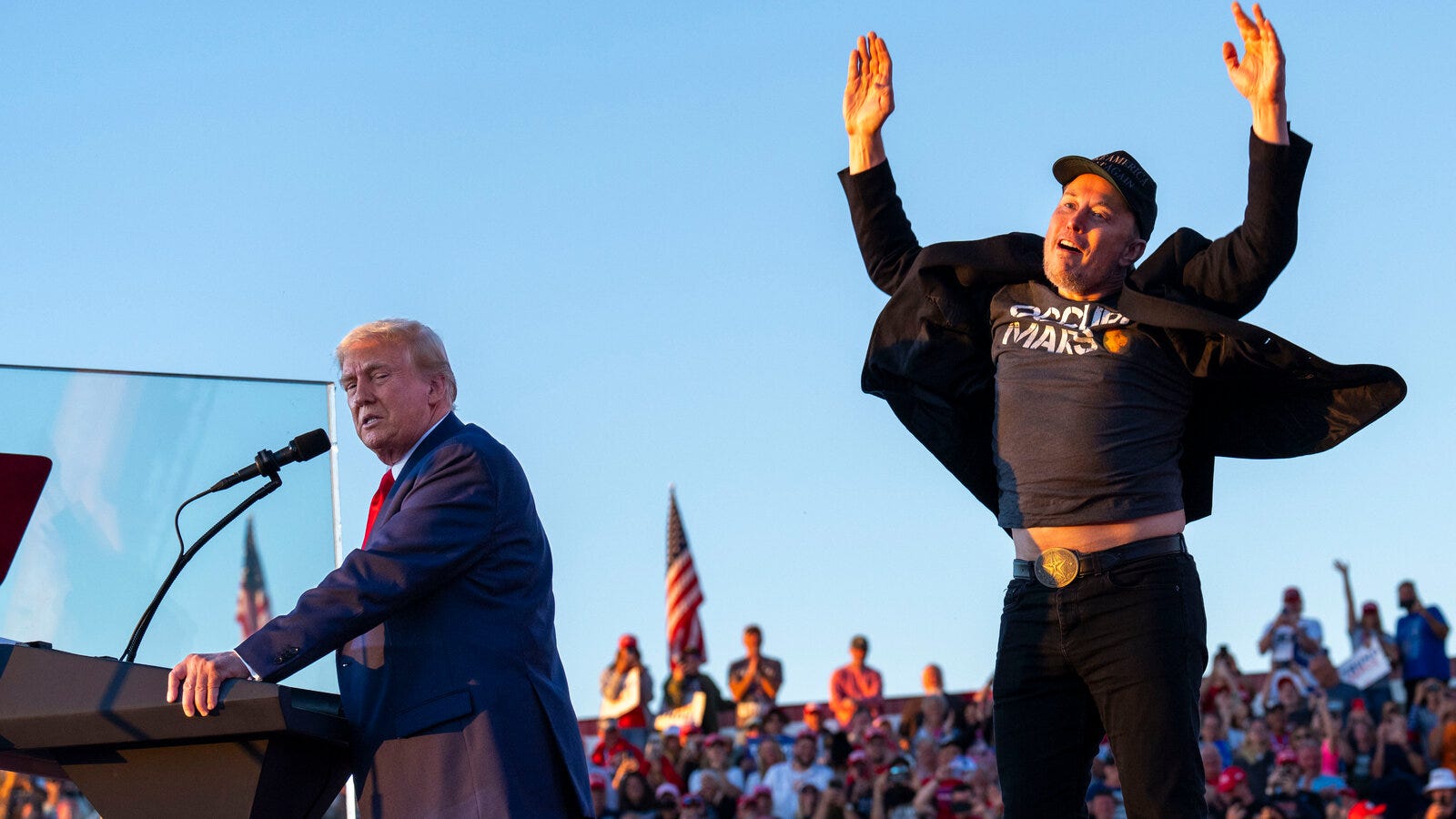
Once again, this makes sense! Tesla should be worth that much because, like with Trump and Truth Social, if Musk posts something on X Republican Congressmen rush to make it happen. Musk now has significant power over the US government, so his companies are more valuable because he will be able to leverage that power to help his companies.
Trump symbolizes the worst of the norm erosion, but the problem did not start with Trump. McConnell keeping Garland out of the Supreme Court stands out to me as an egregious example of norm violation pre-Trump, but there are many others2. Pre-Trump iterations of the Republican Party have had far less respect for norms than Democrats, but frankly I don’t venerate for norms for the sake of them and would be okay with a little bit of dirty politics à la McConnell. I certainly wish the Democrats would at least respond in kind when the Republicans engage in such behavior so that they were on a level playing field.

Compared to McConnell’s antics, this implosion of norms that we’ve seen since Trump won the election is a fundamental shift in the way American politics are practiced. Not Being Corrupt and having a free press are norms that I value, and Trump is trampling on those ideas.
How will political norms in America develop in a post-Trump political environment? It’s not immediately clear. I imagine that even as Trump exits, his political approach will persist; JD Vance takes a lot out of his playbook and will probably not let something like centuries of democratic practice stop him from doing what he wants if he has the means.
Additionally, our young people don’t have much reverence for norms; see the approval ratings of Luigi Mangione, which show high age polarization. 41% of those aged 18-29 say that his actions were at least “somewhat acceptable”. Perhaps this is evergreen, and young folks are always less appreciative of institutions and stability. Or maybe this trend is downstream of something insidious in changes in media consumption patterns, which will disproportionately affect young people.
Sometimes the erosion of norms is funny. I am personally amused when Trump refers to Canada as the 51st state or openly questions Panama’s control over the Panama Canal. And international relations generally could probably use a little more open expression that isn’t mediated through a thick layer of arcane and archaic norms.
But a lot of our norms are good for a reason. This Trumpian system is not conducive to effective governance. Ask anyone from India.
How can we stop or reverse norm erosion in America? I don‘t know. Democrats can call out Trump when he violates norms openly, but it’s not obvious that this will hurt Republicans at the ballot box. The Dems have yet to win points from the public for norm maintenance, and Trump has persevered through temporary small dips in support after his worst previous transgressions, like the January 6 riots. The lesson he’s taken away from all this is that he can continue to act with impunity.
And will Democrats themselves ever pivot away from being a party of norms? Probably not. Our liberal leaders will continue to come from elite institutions that prize propriety, so there is significant institutional pressure to maintain norms within the Democratic Party. However, as these elite institutions continue to lose sway over the American public3 an approach that steadfastly upholds mainstream liberal values will probably not yield the best electoral results.
We may need a god-emperor Alexandria Ocasio-Cortez to take the reins. May the Green New Era be prosperous for everyone, even the haters and losers.

What should we attribute this to? To sketch it out briefly: perhaps some combination of the riots in the wake of George Floyd’s death in 2020, changes in our information environment, the media and other cultural elite institutions moving further left, and typical thermostatic shifts in public opinion wherein the public’s opinion moves in the opposite direction of policy.
Other examples of pre-Trump Republican norm violations include Republican efforts to throw the 2000 presidential election to Bush, the 2013 debt ceiling crisis (which prompted the government shutdown and involved holding the nation hostage in an attempt to axe Obamacare), and… Birtherism, which I suppose was not, strictly speaking, pre-Trump.
For a long time now, these elite institutions have been out of touch with the Democratic base on cultural issues. But people of color still voted blue! Not until the 2024 election did Black and Latino voters finally shift significantly towards Republicans. In 2024, the marginal voter was, for the first time, a Republican; the voter who did not pay that much attention to news swung massively towards Trump.