


Lindsay Clancy. Damn.
It’s a tragic story, if you’ve missed it. In January 2023 a woman killed her three children (aged 5, 3, and 8 months) inside their family home before jumping out of a second-story window. She survived, paralyzed from the waist down. She had been deeply unwell in the preceding months: anxiety, insomnia, a psychiatric admission, and nine medications. She told her nurse practitioner she was having persistent, intrusive thoughts of suicide. When her providers asked whether she had thoughts of harming her children, she said no. Days after the killings, her husband Patrick asked the world to find it within themselves to forgive her, as he had.
The jury is still deliberating as I write this. Massachusetts charged her with first-degree murder. Her defense concedes she killed the children, arguing that postpartum psychosis (she told psychiatrists a voice instructed her to kill her children and then herself) left her unable to understand what she was doing. If the jury agrees, she goes to a secure psychiatric facility instead of prison.
We know, mechanically, how her children died. Both parties agree that she strangled them. The trial is instead about getting inside of Lindsay’s head and understanding whether or not she had the ability to comprehend the gravity of what she did.
And yet. Over dinner last week, someone told me she thinks the husband might have done it. If you spend five minutes scrolling through #clancy on TikTok, you’ll start to understand why she believed that. TikTok users will post clips from the trial, and in the comment section you’ll find incisive analysis such as this:
i believe she believes she did it but I KNOW he did it (12.9k likes)
Someone else said simba thought he killed his dad because the killer told him he did now that’s all I can think about (7740 likes)
He [her ex-husband] has SO many guilty mannerisms (13.1k likes)
And unfortunately, he’s probably gonna get away with it because the justice system is shitty (10.1k likes)
If he’s a Gemini and she’s a Leo, it was toxic between them. He did it. That’s all I need to know. (1.7k likes)
Leo’s don’t kill their cubs. Nope. Not buying it (400 likes)
There’s remarkably poor reasoning on display here. And these people are all in an echo chamber where they’re surrounded by videos confirming their exact suspicions and giving them new ones that fit neatly into the same pro-Lindsay, anti-Patrick groove.
How did we get here?
It couldn’t have happened fifty years ago. In Walter Cronkite’s America the only sources of news were three TV networks and your local paper. As I’ve previously discussed, with such a small number of producers of information the class of people involved in such production was highly unrepresentative. They were often Ivy League-educated, with unusually cosmopolitan beliefs about the world that they propagated through the media. When these gatekeepers decided Watergate was unforgivable, the country immediately agreed and Nixon was forced to resign. Their monopoly on information production has gradually faded since then, and our information environment has radically changed as a result.
Fringe beliefs existed before, but their propagation was limited by geography: if you believed something crazy, you had to find neighbors who believed it too, and mostly you couldn’t. This started to change after deregulation turned radio into a megaphone for bombastic individual personalities like Rush Limbaugh, who told millions that Deputy White House Counsel Vince Foster was killed by the Clintons. Next the internet helped the fringe coordinate among themselves, offering chatrooms or listservs where the same few hundred believers could find each other from anywhere.
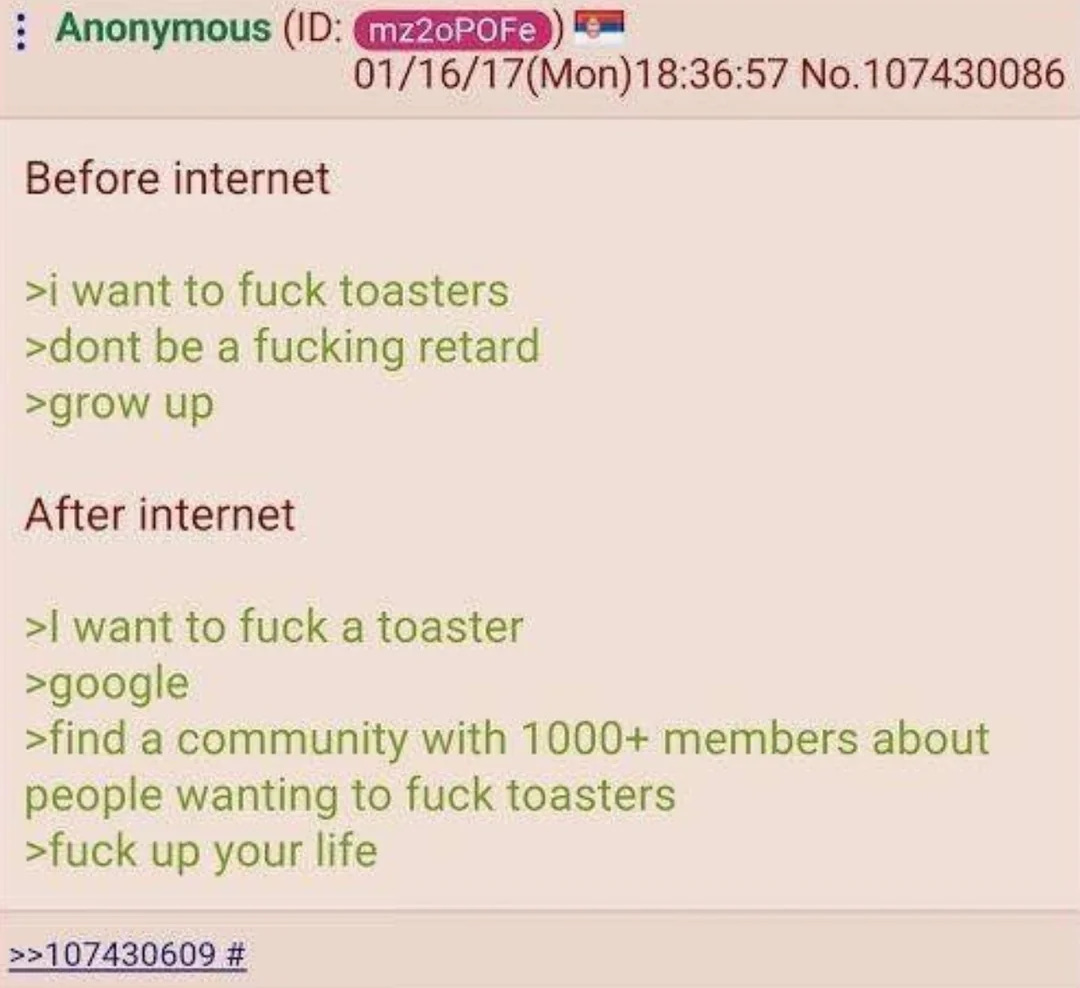
With the advent of Google and the expansion of broadband, all friction between you and the right website disappeared. My mother ran the Boston Globe’s Sunday paper in 2005, at a time when she says the Globe sold 100 pages of classified ads every Sunday for $60,000 each. Craigslist annihilated that business model, but that was just the beginning. Social networks like MySpace and then Facebook developed, capitalizing on network effects to lock in users by creating a sense of FOMO for those who weren’t plugged in. With 2007 came the iPhone, allowing these platforms to follow you everywhere you go.
At the Boston Globe, they described it as a revenue “hockey stick” that went straight down. Ad money drained from traditional media to digital platforms. Today, over 70% of global advertising spend is digital, with most of that captured by Google and Meta.
So an arms race began. Tech companies reorganized themselves around optimizing engagement metrics, which is how they maximized revenue. In 2011 Jeff Hammerbacher, a former data lead at Facebook, bemoaned that “the best minds of [his] generation are thinking about how to make people click ads. That sucks.” Soon after, Facebook started trying to hack the human brain. In 2012, they manipulated the feeds of 700,000 users to try to see if they could change their moods: they succeeded. In 2017, former Facebook president Sean Parker described the platform as a “social-validation feedback loop... exploiting a vulnerability in human psychology,” fretting that “God only knows what it's doing to our children's brains." A 2018 internal slide deck explicitly stated that their “algorithms exploit the human brain's attraction to divisiveness.”
The platforms have converged towards the patterns that maximize engagement. They’ve moved away from longform and towards soundbites, away from positivity and towards division, away from text and towards video. The most potent form available today is shortform video, which rose to prominence through TikTok but now exists on essentially every major platform, from Instagram and YouTube to Spotify and even Substack.
Sometimes people wonder why, as GDP soars, our mental health and satisfaction statistics lag behind. We live in an eternal Vibecession. Matt Yglesias occasionally writes about how typical productivity statistics elide the negative impact on welfare from these digital platforms, which leverage our susceptibility to negativity and division. He cites research indicating that people who deactivate Facebook and Instagram (in an experimental setting) end up happier. Unfortunately, network effects lead to a coordination failure here; another study found that people would need to be paid a lot to unilaterally remove themselves from these platforms, but that they would actually pay to remove themselves and also all their friends.
Brandolini’s Law, coined by an Italian programmer in 2013, states that “The amount of energy needed to refute bullshit is an order of magnitude bigger than that needed to produce it.” So when market forces push us towards a maelstrom of frictionless shortform audiovisual slop, our epistemics suffer because the form leaves no room for refutation. There is a fundamental tradeoff between engagement and epistemics, but the platforms are only interested in optimizing on engagement.1 And so it’s the most optimized platforms, like TikTok, where unhinged perspectives about Lindsay Clancy are most readily embraced; Substack or Reddit tend to be somewhat more reasonable.
Earlier this month, economist-blogger Nicholas Decker called the median voter a Maoist. He cites data suggesting that the American electorate holds wildly contradictory beliefs. Social Security is on track to be insolvent by 2032, and yet when you ask the electorate you find that 80% are against new taxes, 90% are against cuts, 74% are against raising the retirement age, and 76% are against borrowing more money. That’s all from the same poll. In brief, they have poor epistemics. Decker describes his Maoist median voter:
They do not believe in tradeoffs. They believe that, if only everyone were good and honest and working toward the right goals, good things will happen. That politicians disagree with each other is simply a sign that they are corrupt. If the people are good and sincere, then we can simply do things and it will all work out okay.
It’s worth considering Mao’s Great Leap Forward as an informational catastrophe. Decker claims that Mao’s political program held that only “ideological sincerity” was necessary to bring success. Under that framework enthusiasm dissolves all constraints and fanciful economic projections become a loyalty test. When China’s Minister of National Defense Peng Dehuai criticized the widespread practice of inaccurately reporting agricultural statistics, he was forced to debase himself by giving a speech in which he denounced his own previous statements as a “series of absurdities.” It didn’t save him from being purged from party leadership. Many others were also purged during this period.
Mao’s courtiers flattered him out of fear. Today, there doesn’t need to be any sort of threat to force incoherent groupthink; optimizing on engagement still leads to audience capture for information producers and funnels information consumers into echo chambers. Algorithmic feeds learn that disagreement leads to churn, so the machine shows you things you already agree with (and also some ragebait).
This makes political allegiance less elastic, and hence less responsive to both material conditions and scandals. In June, JD Vance compared himself to the once-disgraced Richard Nixon and noted that Watergate would be “like a 12-hour news story” if it happened today, adding that “the idea that it would have taken down a presidency is crazy.” He’s right, of course! Trump has done so much that’s worse than Watergate. But without trusted gatekeepers there to tell us that this stuff is bad, the scandals are unable to change anyone’s mind. After all, the algorithms aren’t interested in the truth. If you already dislike Trump, you’ll hear lots about the most recent terrible thing he did. If you like him, you’ll only experience the scandal through ragebait, with the most easily caricatured liberals shown to conservatives who are supposed to get angry at them.
Decker worries about the consequences of an electorate full of Maoists, writing:
Mao wanted the impossible done. Man cannot do impossible things. The cost of pretending otherwise is death. The voter wants impossible things, too. I do not think the American people are going to starve themselves to death… but the American people have set themselves on an inevitable conflict with reality.
Decker’s remedy is elite rule. “A politician’s job is to do what they think is best for the people, not to do what the people want,” he writes. The people “wish to chew on the pretty foxgloves.”
I do wonder, though: is that their fault, or have these platforms just wrecked our ability to think clearly?
One could argue that platforms like TikTok are actually more “democratic” in some sense than the previous information environment, where information production was restricted to the credentialed elite. There were no rapid feedback loops to allow regular people to influence what information circulated, nor did they have the ability to produce their own information. In contrast, the frictionless setting of a modern digital platform relentlessly tracks engagement to show people what they like while offering its own users the ability to contribute to the discourse. So if what we engage with is tribal and lurid, perhaps that’s just the algorithm revealing something about our own psyches.
However, engagement doesn’t map cleanly to preferences. It tells us what our eyeballs linger over, not what we’d choose if asked, and certainly not what’s best for us. Parker said Facebook was “exploiting a vulnerability,” which sounds more like manipulating us away from some hypothetical natural equilibrium. What would man’s epistemics look like in the mythical state of nature?
Maybe the answer doesn’t matter, if it’s impossible to put the genie back in the bottle. I happen to believe these things are technologically overdetermined. The Luddites lost; the world has yet to see a successful Butlerian Jihad. So capital will march on, discovering ever-more-powerful technologies to hack into our brains. Democracy is now mediated through a layer of digitally-enhanced tribalism and misinformation. I don’t expect that to change.
That’s no reason to give up on guardrails. We should take smartphones out of schools. Yglesias suggested taxing digital ad revenue, which I’d endorse although it does nothing to change the underlying engagement optimization. And while the dynamics at a societal scale are fucked up, thankfully nothing about how you spend your time is overdetermined. You can delete TikTok and Instagram from your phone. You can read writers who make you think. You can call out people who use astrology to analyze criminal proceedings. You can still prioritize truth; the algorithms just won’t do it for you.
Of course, an algorithm could also be optimized towards explicitly political ends. That’s a concern with TikTok especially, as it still leases the algorithm’s source code from the Chinese company that used to own it.
I say this with absolute sincerity: the market is solving it
“the luddites lost” but i’d say this may be your most luddite take yet