
Why Things Could Have Been So Much Worse for Democrats
Kamala ran a strong campaign and was well-situated relative to the broader political environment


In the aftermath of the election, people have been quick to point out Kamala’s shortcomings as a candidate and perceived tactical errors from her campaign. But I believe that the presidential campaign actually pressed many of the right buttons and was positioned well relative to the Democratic party’s popularity nationally by the lack of a primary and a weak opponent in Trump. They were just condemned by an anti-incumbent political environment and a party framework that is out of step with the country more broadly.
First, Trump was was (probably) a weak candidate. This is the point I’m least confident about, as he’s always had a certain maverick charm that gets his fans to come out and vote. But in this election in particular, he just wasn’t an effective advocate for his own candidacy. Trump had very low approval ratings, he wasn’t very active on the campaign trail, and when he was at a rally he bordered on incoherent. I would guess that a candidate like Doug Burgum would have put up much better numbers if he had been in Trump’s place, although we can’t know for sure. I’m curious to see who ends up leading the GOP in four years, when Trump will (most likely) no longer be eligible to run for president.
The more interesting point is about Kamala’s effective coronation to the top of the ticket. Many commentators, including Nancy Pelosi, have complained that the Democrats would have been in better shape had their been an open primary to replace Joe Biden at the top of the ticket. It’s true that there are people who complained that Kamala hadn’t earned her spot on the ballot. And there’s a chance that an open primary could have brought us more charismatic candidate. But the benefits of having a candidate who did not have to go through a primary should not be discounted.
A candidate who is optimizing to win the Democratic primary has to hit very different notes from a candidate who is optimizing to win over the whole country. In fact, many of the Republican talking points around how extreme Kamala was came from when she was running in a primary way back in 2019. Remember Trump’s line from the debate about how Kamala wants to do “transgender operations on illegal aliens that are in prison”? That’s something that she basically supported back in 2019, and it’s something that alienates the broader American electorate while giving her brownie points with the party’s left flank!
To get out of a primary, a candidate would probably have to take some positions like the above. And if they did not take such a position, there would be another politician to their left who would take that position and then antagonize them for their centrism and lack of support for underprivileged groups. This would lead to a toxic environment in social media spaces. I don’t believe that a Kamala Harris who had run against a hyper-progressive candidate like, say, Bernie Sanders would have been able to win over the internet as much as she did. The Democratic nominee Kamala Harris who had positioned herself to the right of Bernie Sanders on trans issues and Gaza during the primary would not have been “brat” in the run-up to the general election. It would have compromised her perceived moral integrity from the get-go and dampened enthusiasm among the young people who dictate much of the online discourse around a candidate.
Without going through a primary, Kamala could be a blank slate. Zoomers and boomers alike could project their (often very different-looking) hopes and dreams onto her. She pivoted hard into the middle culturally, dropping so many of the worst Democratic talking points. I’ve long wanted the Democrats to run away from identity politics and focus their rhetoric on freedom and growth, and Kamala did all the easy stuff there!
She never really talked about how she could be the first female president, or the first Black woman to be president, or the first Indian-American president. In many ways, her status as a Black woman empowered her to move away from identity politics; her cred on these points was assumed. Where Biden had pledged to nominate a Black woman to the Supreme Court, Kamala Harris had to make no such promises. Her campaign’s vision for America strived to be broader than that. This should be a winning formula.
And there’s some evidence that it worked. On average, the swing towards Trump relative to 2020 was significantly smaller in swing states, where her campaign was most visible. But it wasn’t anywhere near enough. Harris was saddled by too much baggage. She’d been a part of an administration that was unpopular with workers despite their status as perhaps the most economically left-wing administration since—I don’t know, FDR? There had been too much accumulated Democratic weirdness, too much signaling over the years that the party was for the Groups rather than for everyday Americans.
A poll from Blueprint presented respondents with 25 reasons to not choose Kamala Harris. They found that among swing voters the most persuasive critique of Kamala Harris was that she “focused more on cultural issues like transgender issues rather than helping the middle class.” The fact that this was the reason that scored highest despite the fact that her campaign tried their best to never talk about transgender issues speaks volumes. The Democratic party is strongly associated with cultural issues that are anathema to so much of America.
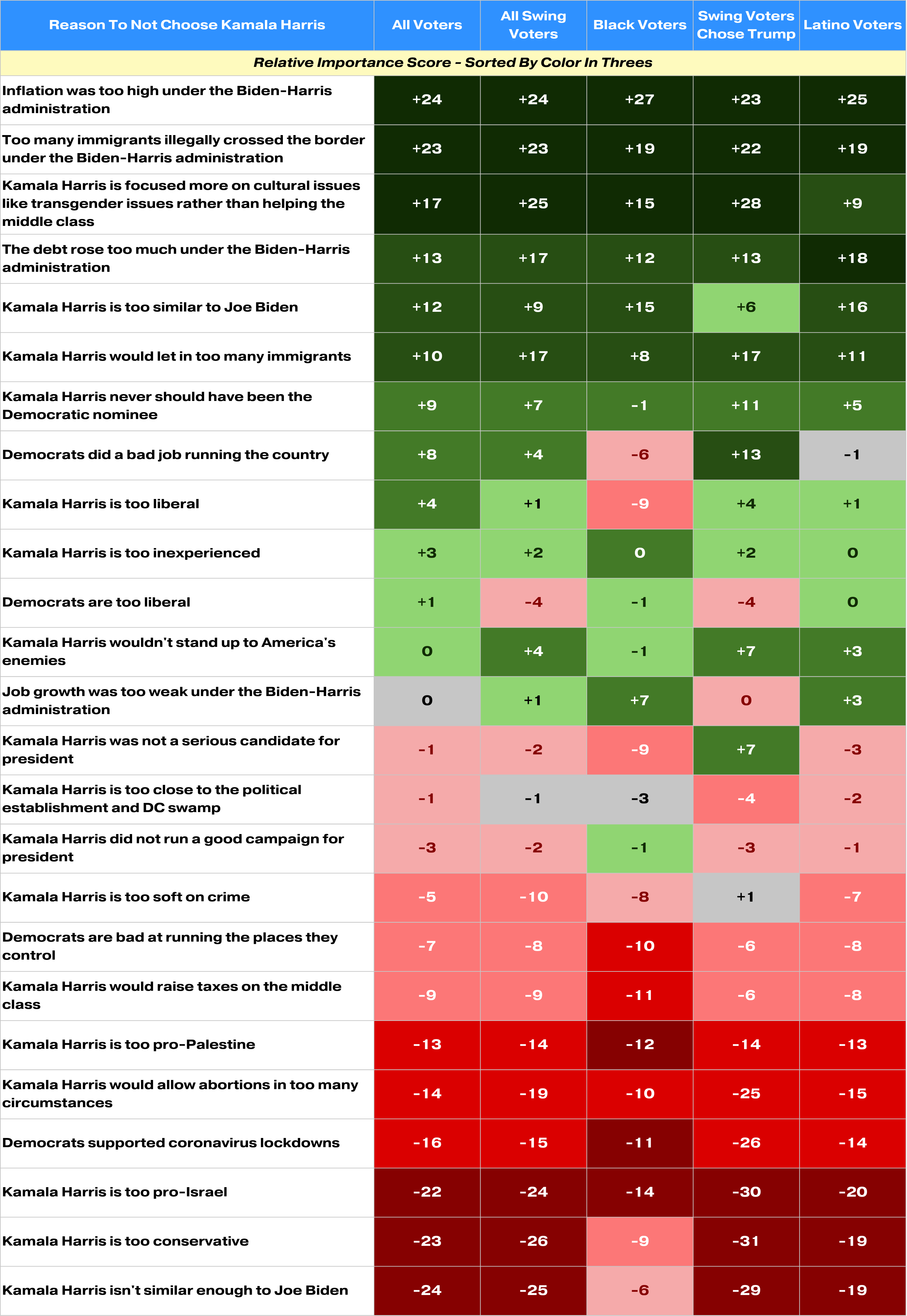
It will be hard for the Democratic party to change this image. There is still so much resistance to active pushback against the party line on cultural issues. Representative Seth Moulton out of Massachusetts expressed some concern around the Democratic party platform on trans issues, saying that he doesn’t want his daughters “getting run over on a playing field by a male or formerly male athlete, but as a Democrat I’m supposed to be afraid to say that.”
Moulton has a history of being a bit of a contrarian, and I don’t personally think that the way that he put this statement was righteous. But Moulton’s quote was still to the left of the median American on this issue. He needs to be able to express opinions like this around shifting the party’s rhetoric without immediate widespread condemnation. But of course he met significant pushback; a top staffer resigned, a city councillor in Salem (a city Moulton represents) called for him to resign, and protests began outside of his office.
Moulton has since doubled down. He has argued that the Democrats should be able to debate this points, but that instead “we have a wing of our party that shames us, that tries to cancel people who try to even bring up these topics, and, frankly, shames voters.”
This is getting to the key point. Too much of America feels like Democrats are urban elites who look down at them for not always knowing what to say, for not believing the right things. A big tent approach is needed, a party platform that is culturally inclusive rather than exclusive because it doesn’t rely on identity politics and takes people for who they are, whoever that is. Kamala Harris ran that campaign as best she could, but she couldn’t undo years of alienation.
I don’t think that fixing this problem just comes down to the Democratic party leadership starting to operate differently. The pushback against Moulton has not come from Minority Leader Hakeem Jeffries or DNC chair Jaime Morrison; it has been diffuse, coming from activists on the ground and local politicians and his peers in the House. For a change to come the Democratic party’s base needs to move away from any ideology that could be feasibly called “woke,” and while I think we’ve seen that shift begin in the last couple years it is far from complete.
Will we be there by 2028? Will the Democratic Party of 2028 be a party that has emotional resonance not just with the coastal elite (like me!) but also with the median voter?
I don’t have a prescription for how we get from here to there. Matt Yglesias’ Common Sense Democrat manifesto is a place to start, providing nine broad guiding principles for messaging and policy. I think that perhaps the most valuable change electorally would be if the Democrats could run an outsider candidate at the top of the ticket, someone who can credibly call out problems in government and promise to address them head on, to change things in Washington.
That kind of positioning would allow the Democrats to finally fight fire with fire, recognizing the discontent with the way that our country’s government has been operating in recent decades by running a change candidate. Kamala Harris was bogged down by representing a status quo that Americans are unhappy with, economic indicators be damned. I doubt that the status quo will get much more popular as time passes, with the trends we’ve seen in our media consumption patterns.

As the Democratic party’s nominee for president, Kamala Harris did an excellent job. And she was blessed by being the nominee without having to stake herself down with views that are out of touch with the electorate. But the Democratic party is culturally toxic right now. Between that toxicity, high inflation rates, and an anti-incumbency wave worldwide, the deck was stacked against her, and things could easily be a lot worse in another four years.